

What is the Beep Test
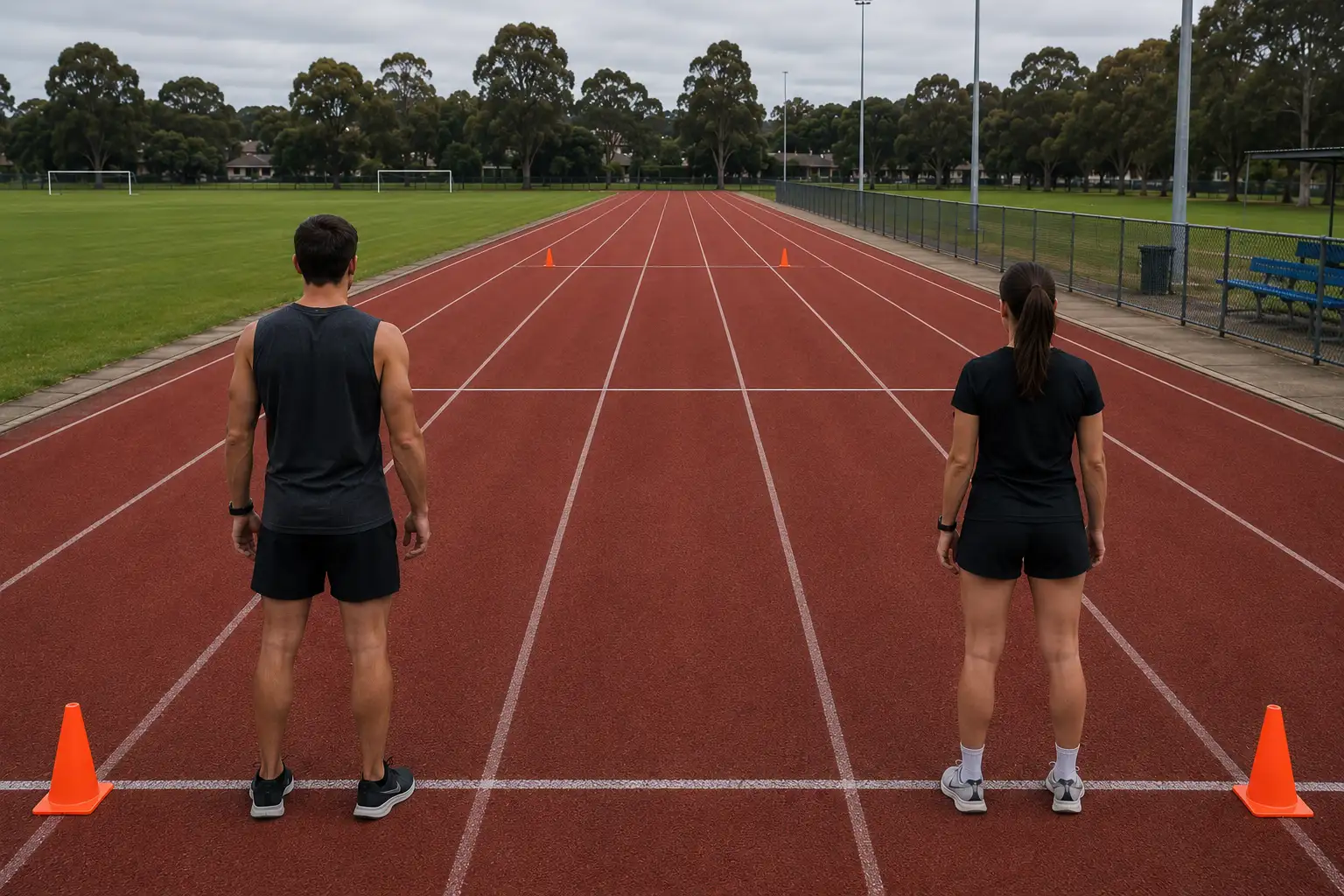
The beep test, also called the bleep test, multi-stage fitness test, pacer test, or 20m shuttle run test, is a running test that estimates your aerobic fitness (VO2max). You run 20 metres back and forth in time with a beep, and the pace gets faster every minute until you can’t keep up with it anymore.
Is the bleep test the same as the beep test?
Yes. Beep test, bleep test, pacer test, PACER (short for Progressive Aerobic Cardiovascular Endurance Run [5]), and multi-stage fitness test (MSFT) all refer to the exact same test, but none of these is actually the original name. Léger’s own research called it the “multistage 20-metre shuttle run test.” The nicknames came later, as the test spread into different countries and programs: “bleep test” in the UK, “beep test” in Australia and New Zealand, and “PACER” when it was adopted into FitnessGram, the American schools fitness program. Whichever name you’ve heard, if it’s running 20 metres in time with an audio beep that speeds up over time, it’s this test.
Who uses the beep test, and why
Two groups rely on the beep test more than anyone else: recruiters and coaches.
Recruitment and emergency services. It’s the standard fitness assessment for police, fire, and military services across Australia and several other countries, including:
- Victoria Police, South Australia Police, Western Australia Police, Queensland Police Service, New South Wales Police Force
- English and Welsh Police, Scottish Police
- Metropolitan Fire Brigade, New South Wales Fire Brigades
- Australian Army, Royal Australian Air Force, Royal Australian Navy
- British Army, Royal Air Force, Royal Navy, Royal Marines
- Canadian Forces, Ontario Provincial Police
- Royal New Zealand Navy
The level required to pass differs between organisations, and sometimes between roles within the same organisation, but the test itself is identical everywhere. It’s popular for this precisely because it’s cheap and fast to administer to a whole intake of applicants at once, and the result is a genuinely reliable read on someone’s aerobic fitness in under 20 minutes.
Sport. Beep test benchmarks also show up across AFL and NFL football, soccer, rugby, hockey, basketball, netball, handball, and tennis, usually as a pre-season fitness check rather than a straight pass-or-fail hurdle. Coaches like it for the same reason recruiters do: it’s a fast, repeatable way to track a whole squad’s fitness over a season without any equipment beyond a phone and some open ground.
It doesn’t care how fit you already are
One of the odd things about the beep test is that it doesn’t discriminate. Whether you’re a serious athlete or you haven’t trained in years, everyone ends up in the same place eventually: out of breath, at their limit. The only difference is how long it takes you to get there.
That’s actually the point. The test isn’t measuring how hard you can push for thirty seconds, it’s measuring how much aerobic engine you’re carrying, which is what VO2max actually is. Two people can look equally unfit walking in the door, and finish the test a level and a half apart, because one of them has built more of that engine than the other.
It’s worth being precise about what your score actually gives you, though: it’s not a lab measurement, it’s a prediction. Your level gets run through a formula that’s been checked against real VO2max testing in exercise labs [4], and for most people that prediction holds up well. It’s less reliable at the edges: very unfit beginners, older adults, and highly trained endurance runners (who lose time in the turns compared to straight-line running) tend to see a bigger gap between their beep test score and a lab-tested VO2max than the average person will.
Where it came from
The beep test was co-developed in 1982 by Luc Léger and J. Lambert, researchers at the University of Montreal [1]. Their original protocol started runners at 8 km/h with two-minute stages, as a simple way to estimate aerobic capacity without a treadmill or lab equipment. It was revised in 1988 to the one-minute-stage format used almost everywhere today [2].
Each level today lasts about a minute and is broken into 20 metre “shuttles,” one run back and forth between the two markers. As the levels climb, the beeps come faster, so you need more shuttles inside that same minute just to keep up.
Two slightly different starting speeds are still in use. Léger’s own protocol starts level 1 at 8.5 km/h [1]. Some organisations, including Victoria Police and other Australian agencies, use a version that starts at 8.0 km/h instead [3], a variant that traces back to the Eurofit fitness-testing battery from the 1980s. Both converge from level 2 onward, increasing by 0.5 km/h each level, so the difference only really matters for your first shuttle. Our complete guide to running the beep test has the full level-by-level breakdown if you need it.
If you’ve got a real beep test coming up, whether it’s a job application or a team trial, we cover how to actually train for it and what equipment you’ll need elsewhere on the site.
Funny enough, the original test had two co-developers too. This training program does as well: my mate Russ built it, and I built the course around it. I went through the full thing myself at 40, and took my own score from Level 10 to Level 12.5 in six weeks, so I’ve seen firsthand that the gap between “reasonably fit” and “beep test fit” is real, but closeable with the right training, not just more running.
Sources
- Léger, L.A. & Lambert, J. (1982). A maximal multistage 20-m shuttle run test to predict VO2 max. European Journal of Applied Physiology, 49, 1-12. link.springer.com/article/10.1007/BF00428958
- Léger, L.A., Mercier, D., Gadoury, C. & Lambert, J. (1988). The multistage 20 metre shuttle run test for aerobic fitness. Journal of Sports Sciences. pubmed.ncbi.nlm.nih.gov/3184250
- Multi-stage fitness test. Wikipedia. en.wikipedia.org/wiki/Multi-stage_fitness_test
- Does the Multistage 20-m Shuttle Run Test Accurately Predict VO2max in NCAA Division I Women Collegiate Field Hockey Athletes? pmc.ncbi.nlm.nih.gov/articles/PMC8229670
- The PACER Test. FitnessGram. fitnessgram.net/pacer-test
Ready to Pass Your Beep Test?
Stop guessing your way to test day. The Beep Test Training Program shows you exactly how to reach your target level, from pacing and turning technique to structured training sessions.
